
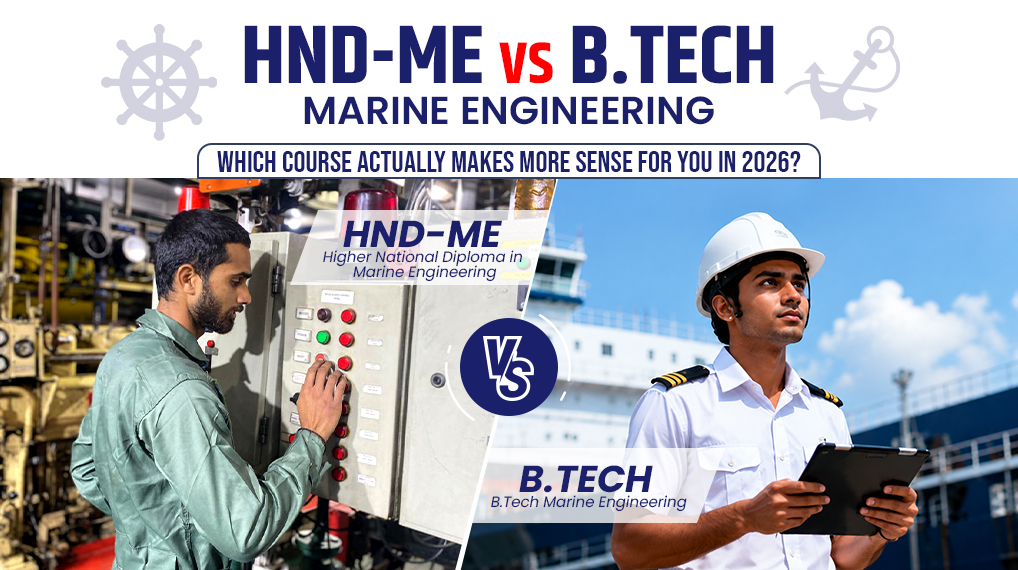
HND-ME vs B.Tech Marine Engineering: Which Course Actually Makes More Sense for You in 2026?
Students asking about HND ME vs BTech Marine Engineering is the most common question we get every admission season. Every year, somewhere between April and June, we get a flood of calls and messages from students who’ve just finished their 12th boards and are now stuck in this exact dilemma — HND-ME or B.Tech Marine Engineering? Both lead to the engine room. Both need PCM. Both end up with you working as a Marine Engineer Officer. So what’s actually different?
Quite a bit, as it turns out. And picking the wrong one for your specific situation can cost you time, money, or both. So let’s go through this properly.
What Are These Two Courses, Really?
Before the comparison, just to make sure we’re on the same page:
HND-ME (Higher National Diploma in Marine Engineering) is a 2-year pre-sea training program approved by DG Shipping, offered through UK MCA-affiliated institutes. It gets you to a Class IV Marine Engineer Officer Certificate of Competency through a shorter, more focused route. You spend roughly the first year training in India and the second year completing the program with UK MCA-approved content.
B.Tech Marine Engineering is a 4-year undergraduate engineering degree — full residential, structured into 8 semesters, approved by Indian Maritime University (IMU) and DG Shipping. It’s a program designed to prepare graduates to work in the maritime industry as Marine Engineers, covering both theoretical and practical aspects across subjects like Marine Machinery Systems, Marine Internal Combustion Engines, Naval Architecture, and Marine Boilers.
Both eventually lead to the same destination — a 4th Engineer berth onboard — but the road there looks very different.
Course Duration: 2 Years vs 4 Years
This is the most obvious difference, and for a lot of families it’s the deciding one.
HND-ME: ~2 years of pre-sea training, followed by the required sea time and COC exam.
B.Tech Marine Engineering: 4 years of full-time residential study, followed by 12 months of mandatory onboard engine room training before appearing for the 4th Engineer COC exam.
So realistically you’re looking at 2-2.5 years to sea on the HND-ME route, versus 5-5.5 years on the B.Tech route before you’re actually earning a proper salary at sea. That’s a meaningful difference if your family is counting on you starting to earn sooner rather than later.
Fees Comparison: What Does Each Actually Cost?
This is where it gets interesting, because the numbers are quite different.
HND-ME fees at a DG Shipping-approved institute are generally more affordable than a full 4-year degree — typically ranging between ₹3.5 to ₹7 lakh total for the course, depending on the institute.
B.Tech Marine Engineering fees vary more widely. Fees typically range from INR 2.5 to 10 lakh at private colleges, while government institutions charge around INR 1 to 4 lakh. That said, some good government colleges like MERI Mumbai and MERI Kolkata charge between 9 to 11 lakhs, while fees in private colleges for B.Tech Marine Engineering can go up to 24 lakhs.
So you’re comparing roughly ₹4-7 lakh (HND-ME) against ₹9-24 lakh (B.Tech) — and that’s before you factor in 2 extra years of hostel, food, and living costs on the B.Tech side.
Eligibility: Who Can Apply for Which?
HND-ME Eligibility:
- 12th pass with Physics, Chemistry, Mathematics (PCM)
- Minimum ~35% in PCM, 50% in English (varies slightly by institute)
- Age: 17–25 years
- Medical fitness as per DG Shipping norms
B.Tech Marine Engineering Eligibility:
- 12th pass with PCM — candidates must have successfully passed their senior secondary examination with at least 60% marks in Physics, Chemistry, and Mathematics, and secured a minimum 50% marks in English either in Class X or Class XII.
- Entrance exam: IMU CET is the main one, along with JEE Main for some institutes
- Age: 17–25 years (with relaxations for SC/ST/OBC)
- Medical fitness as per DG Shipping norms
Key difference: HND-ME has a lower PCM marks requirement, which opens it up for students who scored in the 35-55% range in PCM but didn’t hit the 60% cutoff that B.Tech programs typically ask for.
Salary After Course: Is There a Difference?
Here’s what most students actually want to know.
The honest answer: salary at sea depends far more on your rank and the company you join than on whether you did HND-ME or B.Tech. A 4th Engineer is a 4th Engineer, regardless of which route got them there. The COC is what counts.
That said, here’s a realistic range:
| Rank | Monthly Salary (Approx.) |
| Engineering Cadet / Trainee | ₹30,000 – ₹80,000 |
| 4th Engineer | ₹1.5L – ₹2.5L |
| 3rd Engineer | ₹2.5L – ₹4L |
| 2nd Engineer | ₹4L – ₹8L |
| Chief Engineer | ₹10L – ₹20L+ |
A Chief Engineer on international vessels can earn more than USD 5,500 per month depending on vessel type and company — and marine engineers receive tax-free income (as per NRI rules), free accommodation and food onboard, medical insurance, travel benefits, and paid leave after contract completion.
Both HND-ME and B.Tech graduates enter at the Cadet/4th Engineer level. The trajectory from there is identical.
Career Scope: Which One Opens More Doors?
B.Tech gives you a formal engineering degree — which matters if you ever want to move to shore-based roles in shipbuilding, port management, offshore drilling, or even pursue an M.Tech or MBA later. It’s a full undergraduate degree recognized outside the maritime world too.
HND-ME is more sea-focused — it’s purpose-built for getting you onto a ship and up the COC ladder. If your goal is to sail, reach Chief Engineer, and build a career at sea, HND-ME is a perfectly solid route. But if you’re not 100% sure you want to stay at sea forever, the B.Tech gives you a bit more flexibility to pivot later.
Marine engineers are in demand worldwide, offering opportunities to work with leading shipping companies, offshore industries, and maritime research organisations — and the rising demand for eco-friendly vessels and smart shipping solutions has boosted the need for marine engineers significantly.
So Which One Is Actually Better for You?
There’s no universal answer, but here’s how to think about it:
Pick HND-ME if:
- You want to start earning sooner (sea career in ~2-2.5 years vs 5+ years)
- Your PCM marks are in the 35-55% range
- Budget is a genuine consideration for your family
- You’re clear you want a sea career and not necessarily a shore-based engineering role later
Pick B.Tech Marine Engineering if:
- You scored 60%+ in PCM and have a realistic shot at IMU CET
- Your family can support a longer course without financial strain
- You want the flexibility of a full engineering degree for both sea and shore options
- You’re interested in roles beyond sailing — shipbuilding, naval architecture, marine research
Both are DG Shipping-approved. Both are respected by international shipping companies. The difference is really about your personal situation — timeline, marks, budget, and long-term goals.
FAQ Schema
Q1: Is HND-ME better than B.Tech Marine Engineering?
Neither is universally “better” — it depends on your situation. HND-ME is shorter (2 years), more affordable, and has lower PCM mark requirements, making it better if you want to go to sea faster or your marks didn’t hit the 60% B.Tech cutoff. B.Tech is a full 4-year engineering degree with more flexibility for shore-based careers later. Both lead to the same 4th Engineer COC.
Q2: What is the duration of HND-ME vs B.Tech Marine Engineering?
HND-ME is a 2-year program. B.Tech Marine Engineering is a 4-year program. After HND-ME you’ll typically be sailing in about 2-2.5 years; after B.Tech it’s closer to 5-5.5 years once you include the mandatory 12-month sea training.
Q3: What are the fees for HND-ME vs B.Tech Marine Engineering in India?
HND-ME fees typically range from ₹3.5 to ₹7 lakh at approved institutes. B.Tech Marine Engineering fees range from ₹9 to ₹24 lakh at private colleges, and ₹9 to ₹11 lakh at government institutes like MERI Mumbai or Kolkata.
Q4: What is the eligibility for HND-ME Marine Engineering?
12th pass with PCM, minimum approximately 35% in PCM and 50% in English, age 17-25 years, and medical fitness as per DG Shipping standards. No entrance exam like IMU CET is required for most HND-ME programs.
Q5: What is the eligibility for B.Tech Marine Engineering?
12th pass with PCM with at least 60% marks, plus a qualifying score in IMU CET or other accepted entrance exams. Age 17-25 years and DG Shipping-approved medical fitness are also required.
Q6: Is the salary the same after HND-ME and B.Tech Marine Engineering?
Yes, at the starting rank (4th Engineer/Cadet) the salary is essentially the same regardless of route. Salary depends on rank, company, and ship type — not on which course you took to get there. Both routes lead to the same COC and the same career ladder.
Q7: Can I do HND-ME at Training Ship Varren?
Yes. Training Ship Varren (TSV), Navi Mumbai is a DG Shipping-approved institute (MTI No. 206087) offering the HND-ME program. Contact 1800 268 2891 or visit trainingshipvarren.com for admission details.
Q8: Which course is better for getting into international shipping companies?
Both are recognized by international shipping companies. Companies care about your COC rank and practical competence, not specifically whether you did HND-ME or B.Tech. Sponsored B.Tech programs (e.g., AMET with Maersk, IMI with MSC) do offer guaranteed placements with those companies, but come with higher competition and fees.
If you’re still unsure which path fits your marks, budget, and goals — just give us a call at Training Ship Varren, Navi Mumbai. We’ve helped hundreds of students work through exactly this decision, and we’d rather give you an honest answer than a sales pitch. Call 1800 268 2891 or apply here.