
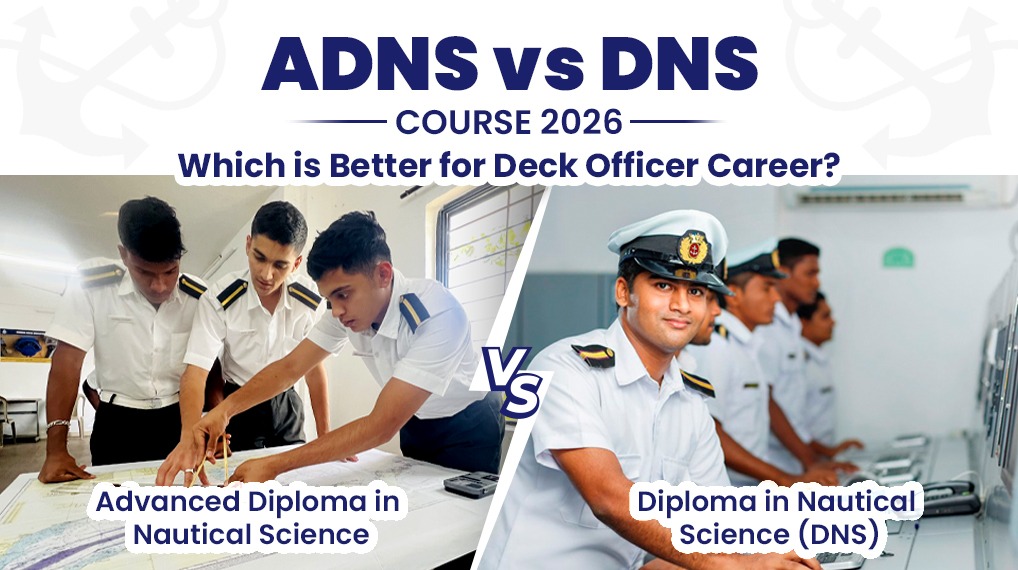
ADNS vs DNS — Which Nautical Science Course Actually Makes More Sense in 2026?
Every year, somewhere between March and June, we get the same question on almost every counselling call from a 12th PCM student — “What’s the difference between ADNS and DNS?” And honestly, the confusion is justified.Both courses prepare you for a Deck Officer career in the Merchant Navy. Students with PCM in 12th can apply for either route. On the surface, they sound almost identical — which is exactly why the confusion exists.
Let’s get into it properly — because picking the wrong one for your specific situation can cost you time, money, and in some cases, the course itself.
First — What Is ADNS and What Is DNS?
Before the comparison, a quick clarification on naming because this trips people up constantly.
ADNS (Advanced Diploma in Nautical Science) — formerly known as HND-NS (Higher National Diploma in Nautical Science) — is a UK-affiliated 2-year pre-sea training program approved by the Maritime and Coastguard Agency (MCA), UK. India offers this course in collaboration with UK institutions like City of Glasgow College. The name changed from HND-NS to ADNS recently, but the course structure and UK affiliation remain the same. When you see “HND-NS” on older materials, it’s the same course.
DNS (Diploma in Nautical Science) is a 1-year pre-sea training program run under Indian Maritime University (IMU) and approved by DG Shipping, Government of India. This is the standard Indian route to becoming a Deck Officer — after DNS, students complete 18 months of onboard sea training, after which they receive the ADNS qualification and become eligible to appear for the Second Mate Certificate of Competency.
Here’s the part that surprises a lot of people: DNS graduates eventually receive the ADNS qualification too — after completing their mandatory sea time. So in a sense, ADNS is actually the end qualification for both routes. The difference is in how you get there.
The Key Differences — Side by Side
| Feature | ADNS (HND-NS) | DNS (IMU Route) |
|---|---|---|
| Full Name | Advanced Diploma in Nautical Science (formerly HND-NS) | Diploma in Nautical Science |
| Awarding Body | UK MCA / City of Glasgow College | Indian Maritime University (IMU) |
| Duration | 2 years (1 year India + 1 year UK) | 1 year classroom + 18 months sea time |
| Entrance Exam | No IMU CET required | IMU CET mandatory |
| PCM Requirement | 50% aggregate in PCM + 50% English | 60% aggregate in PCM + 50% English |
| English Requirement | IELTS 5.5 before going to UK | No IELTS required |
| Sponsorship | Usually required before admission | Required at most institutes |
| Fees (Approx.) | ₹6–12 lakh total (India + UK) | ₹3–8 lakh (varies by institute) |
| Recognition | International — UK MCA approved | India — DG Shipping / IMU approved |
| Career Destination | Deck Officer — same COC track | Deck Officer — same COC track |
What Is the Difference in Marks Required?
This is where the ADNS route genuinely opens a door for students who couldn’t hit the DNS cutoff.
DNS (IMU Route) requires a minimum of 60% aggregate in PCM in 12th, plus passing IMU CET. The 60% mark is a firm cutoff at most IMU-affiliated institutes and shipping company sponsored programs. If you’re below that, you simply can’t apply for the IMU DNS route — regardless of how motivated you are.
ADNS (HND-NS) at institutes like Training Ship Varren requires 50% aggregate in PCM in 12th, plus 50% in English. No IMU CET. No entrance exam pressure. Additionally, you’ll need to clear IELTS with a score of 5.5 before proceeding to the UK component in year two — but that’s manageable with preparation and most institutes guide you through it.
So for students who scored between 50-59% in PCM — ADNS is often the only officer-level nautical science route available to them.
The IMU CET Factor — Why It Matters More Than People Think
DNS through the IMU route isn’t just about marks. Furthermore, it involves clearing IMU CET — the Indian Maritime University Common Entrance Test — which adds a layer of competitive pressure on top of your 12th board results.
IMU CET covers Mathematics, Physics, Chemistry, English, and General Knowledge. In 2026, over 1 lakh students appeared for IMU CET — a number that’s been growing every year. As a result, even students with good marks sometimes don’t make the cut due to exam day performance, and end up losing a year.
ADNS bypasses IMU CET entirely. Therefore, if you’re a student who performs better in continuous assessment than high-stakes entrance exams, or if you’ve already missed the IMU CET window for this year, ADNS is a genuinely faster route to start your officer career without waiting another year.
ADNS vs DNS — The UK Component Explained
One thing students and parents often worry about with ADNS is the UK year. Here’s what it actually involves — because it’s less complicated than it sounds.
The typical ADNS structure at TSV is: Phase 1 (approximately 42-45 weeks) at the institute in India, covering navigation, seamanship, meteorology, ship stability, cargo operations, and STCW safety certifications. Phase 2 is approximately 40-45 weeks at City of Glasgow College, UK — completing the UK component of the qualification with international classmates and faculty.
After that, you need to complete your sea time (on-ship training), following which you’re eligible for the Deck Officer of the Watch Certificate of Competency — the same COC that DNS graduates work toward.
The UK year is actually one of the advantages of ADNS, not a complication. Moreover, you get international exposure, UK academic certification, and a qualification recognized by shipping companies worldwide — not just in India.
Does ADNS or DNS Get Better Placement?
ADNS / HND-NS graduates tend to get picked up by international shipping companies more readily because the UK MCA certification is globally recognized. Companies operating international fleets — Maersk, Anglo-Eastern, BSM, Synergy, V. Ships — all recognize the qualification. Additionally, the UK year itself exposes you to the international maritime community in ways that classroom-only training doesn’t.
DNS (IMU route) placement depends heavily on which institute you attend and whether you have company sponsorship from the start. Sponsored DNS programs (through companies like Anglo-Eastern, Great Eastern, etc.) are excellent — you essentially have a job before you start training. Non-sponsored DNS can be harder to convert to a first contract because there are more graduates competing for the same openings.
At Training Ship Varren, we provide placement assistance for ADNS students and have active relationships with reputed Indian and international shipping companies. Additionally, we help cadets through the UK year logistics — IELTS preparation, visa guidance, and college coordination with City of Glasgow.
In addition to base salary, you receive free food and accommodation onboard, free travel to/from the ship, and medical coverage. Furthermore, once you spend 183+ days at sea in a financial year, your income qualifies as tax-free under NRI rules — making the effective take-home significantly higher than the gross figures above.
Both ADNS and DNS graduates enter at the Deck Cadet level and follow the same progression. Therefore, the long-term salary potential is identical — the difference is only in how you get there and how quickly.
So Which One Should You Actually Choose?
Here’s the honest version, without the sales pitch:
Choose ADNS (HND-NS) if:
- Your PCM marks are between 50–59% — DNS won’t be accessible to you
- You want to skip IMU CET and start training faster
- You want international recognition (UK MCA certification) from day one
- You’re open to spending a year in the UK as part of your course
- You want to work with international shipping companies from the start
Choose DNS (IMU Route) if:
- Your PCM marks are 60%+ and you’re confident about IMU CET
- You have or can get company sponsorship for a sponsored DNS program
- You prefer a fully India-based course with no UK travel component
- You’re aiming for jobs with Indian shipping companies primarily (SCI, GE, etc.)
Honestly, for students in the 50–60% PCM range in 2026 — ADNS is not a backup plan. It’s often the better plan. The UK certification opens more doors internationally than the IMU route does, and the absence of IMU CET pressure means you can start your maritime career a year earlier than someone who spends a year preparing and retaking the entrance exam.
Frequently Asked Questions (FAQ Schema)
Q1: What is the difference between ADNS and DNS course in India?
ADNS (Advanced Diploma in Nautical Science, formerly HND-NS) is a 2-year UK MCA approved course offered in collaboration with UK colleges like City of Glasgow. DNS (Diploma in Nautical Science) is a 1-year IMU-approved Indian course followed by 18 months of sea training. Both lead to a Deck Officer career, but ADNS has lower PCM marks requirement (50% vs 60%), requires no IMU CET, and carries UK MCA international recognition.
Q2: What is ADNS formerly known as?
ADNS stands for Advanced Diploma in Nautical Science, formerly known as HND-NS (Higher National Diploma in Nautical Science). The name changed but the course structure, UK MCA approval, and collaboration with City of Glasgow College remain the same.
Q3: What is the eligibility for ADNS course in 2026?
Candidates must have passed 12th standard with Physics, Chemistry, and Mathematics with a minimum 50% aggregate in PCM, and minimum 50% in English in either 10th or 12th. Age limit is generally up to 25 years. Candidates must also be medically fit as per DG Shipping standards including 6/6 vision, no colour blindness, and physical fitness for sea service. IELTS 5.5 is required before proceeding to the UK component in year two.
Q4: Is IMU CET required for ADNS admission?
No. ADNS (HND-NS) does not require IMU CET. This is one of the key differences from the DNS route. The institute handles ADNS admission through its own process— written test, interview, and medical fitness test.
Q5: What is the fee for ADNS course in India?
ADNS course fees typically range from ₹6 to ₹12 lakh total, covering both the India component and the UK component. Fees vary by institute. At Training Ship Varren, call 1800 268 2891 for the current fee structure and payment plans.
Q6: Does ADNS require sponsorship from a shipping company?
Most ADNS programs require or strongly recommend sponsorship from a shipping company before admission. At Training Ship Varren, we assist students in connecting with sponsoring companies as part of our placement support. Call us to know more.
Q7: What is the salary after ADNS course in Merchant Navy?
After completing ADNS and sea time, you start as a 3rd Officer earning approximately USD 1,800–2,800 per month (₹1.5L–2.3L). With experience, progression to Chief Officer and Captain salaries of USD 8,000–15,000+ per month is realistic. Income is tax-free for seafarers spending 183+ days at sea per financial year.
Q8: Does Training Ship Varren offer ADNS course?
Yes. Training Ship Varren (MTI No. 206087) offers the Advanced Diploma in Nautical Science (ADNS, formerly HND-NS) in collaboration with City of Glasgow College, UK. The UK Maritime and Coastguard Agency (MCA) approves this course. September 2026 batch admissions are currently open. Call 1800 268 2891 or visit trainingshipvarren.com for details.
If you’re stuck deciding between ADNS and DNS — or if someone already told you your PCM marks rule out the DNS route and you’re not sure what’s next — give us a call at Training Ship Varren, Navi Mumbai. We’ve helped hundreds of students navigate exactly this decision, and we’d rather give you a straight answer than a brochure. Call 1800 268 2891 or apply here.
Also check the DG Shipping official portal for institute approvals and the Indian Maritime University website for DNS admission details.