
Walk into any maritime counselling session and this question comes up within the first five minutes. A student — or more often a parent — wants to know: are these the same thing? If not, what’s actually different? And which one is the right career choice?
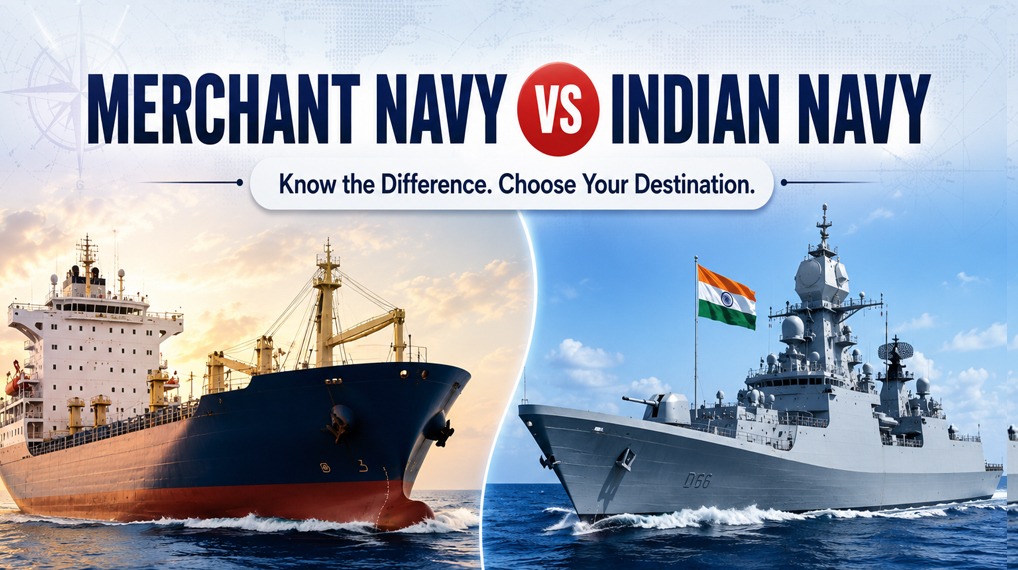
The confusion is understandable. Both involve ships, both involve the sea, and both involve uniforms that look remarkably similar to people who don’t work in either. But Merchant Navy vs Indian Navy as career choices are about as different as a private airline and the Indian Air Force. Same sky, completely different jobs.
So let’s go through what actually separates them — purpose, salary, lifestyle, eligibility, career growth, and which one suits which kind of person.
The Fundamental Difference — Purpose
This is where everything starts.
The Merchant Navy is a civilian commercial profession. Merchant ships carry cargo — containers, crude oil, LNG, vehicles, grain, chemicals — between ports around the world. Additionally, some vessels carry passengers on cruise routes. The Merchant Navy is essentially the logistics backbone of international trade. It operates under private and international shipping companies, regulated in India by the Directorate General of Shipping (DGS), Government of India.
The Indian Navy is a branch of the Indian Armed Forces. Its purpose is to protect India’s maritime borders, conduct naval operations, provide strategic deterrence, and respond to maritime threats. Furthermore, the Indian Navy contributes to international peacekeeping and conducts humanitarian operations when required. It operates under the Ministry of Defence, Government of India.
One is a commercial industry. The other is a military service. That single difference shapes everything else — the training, the lifestyle, the salary structure, the career path, and the kind of person each suits.
Merchant Navy vs Indian Navy — Key Differences at a Glance
| Feature | Merchant Navy | Indian Navy |
|---|---|---|
| Type | Civilian / Commercial | Military / Defence |
| Employer | Private / International Shipping Companies | Government of India |
| Purpose | Global trade and cargo transport | National defence and maritime security |
| Entry After 12th | GP Rating, DNS, ADNS, HND-ME | NDA, CDS, TES, MR, Agniveer |
| Entry After Graduation | DNS, HND-ME, GME, ETO | CDS, SSC Officer entry |
| PCM Required | Yes (for officer courses) | Yes (for officer courses) |
| Entrance Exam | IMU CET / Institute exam / Sponsorship exam | NDA / CDS / SSC / Agniveer MR |
| Training Location | DG Shipping approved maritime institutes | INS establishments (Kochi, Lonavala, etc.) |
| Salary (Starting) | ₹25,000 – ₹85,000/month | ₹56,100 – ₹1,77,500/month (7th Pay) |
| Salary (Senior) | ₹8L – ₹20L+/month (tax-free) | ₹2L – ₹2.5L/month + pension + perks |
| Tax Benefits | Income tax-free (183+ days at sea as NRI) | Standard government taxation applies |
| Job Security | Contract-based (4–9 months per contract) | Permanent government service |
| Pension | No pension | Yes — lifelong pension after service |
| Time Away From Home | 4–9 months per contract at sea | Frequent transfers, postings, deployments |
| Retirement Age | No fixed retirement — sail as long as medically fit | 58–60 years (varies by rank) |
| After-Service Options | Pilot, marine surveyor, port management, maritime law | Government positions, PSUs, defence consulting |
Salary Comparison — Merchant Navy vs Indian Navy
This is the part most students and parents actually want to know about first.
Merchant Navy Salary in 2026
Merchant Navy salary in India ranges from ₹25,000 per month for a fresher GP Rating cadet to over ₹20 lakh per month for an experienced Captain on an LNG vessel — making it one of the highest-paying careers accessible directly after 12th grade.
| Rank | Monthly Salary |
|---|---|
| GP Rating / Deck Cadet (Fresher) | ₹25,000 – ₹85,000 |
| 3rd Officer / 4th Engineer | ₹1.5L – ₹2.5L |
| 2nd Officer / 3rd Engineer | ₹2.5L – ₹4.5L |
| Chief Officer / 2nd Engineer | ₹4.5L – ₹8L |
| Captain / Chief Engineer | ₹10L – ₹20L+ |
In addition to base salary, the company provides free food, accommodation, travel to and from the ship, and medical coverage. Furthermore, most active seafarers qualify as Non-Resident Indians (NRIs) by spending 183 or more days outside India per financial year — meaning their income is completely exempt from Indian income tax.
Indian Navy Salary in 2026
Indian Navy officers earn salaries under the 7th Pay Commission structure with additional allowances:
| Rank | Monthly Salary (Approx.) |
|---|---|
| Agniveer MR (Starting) | ₹30,000 (in-hand ₹21,000) |
| Sub Lieutenant | ₹56,100 + allowances |
| Lieutenant | ₹61,300 + allowances |
| Lieutenant Commander | ₹69,400 + allowances |
| Commander | ₹1,31,100 + allowances |
| Captain (Navy) | ₹1,39,600 + allowances |
| Rear Admiral and above | ₹1,77,500 + allowances |
The Honest Verdict on Salary
Raw monthly earnings — Merchant Navy wins clearly, especially at senior ranks. However, when you factor in pension, lifelong medical, housing, and job security — the Indian Navy provides better long-term financial security for people who value stability over peak earning potential.
Eligibility — How Do You Enter Each?
Merchant Navy Eligibility After 10th
- GP Rating course — 10th pass, any stream, minimum 40% marks, age 17.5–25. No PCM required — the most accessible entry into the Merchant Navy.
Merchant Navy Eligibility After 12th
- ADNS / HND-NS — 12th PCM, minimum 50% aggregate, age up to 25. UK MCA approved international route to Deck Officer.
- DNS (IMU route) — 12th PCM, minimum 60% aggregate, clear IMU CET, age up to 25. Sponsorship mandatory.
- HND-ME — 12th PCM, minimum 35% aggregate, age up to 25. UK MCA approved route to Marine Engineer Officer.
Indian Navy Eligibility After 12th
- NDA (Naval Academy) — 12th PCM pass, age 16.5–19.5, clear UPSC NDA exam
- Agniveer MR — 10th pass, age 17.5–21
- Senior Secondary Recruit (SSR) — 12th PCM pass, age 17–20
Indian Navy Eligibility After Graduation
- CDS (Combined Defence Services) — graduation, clear UPSC CDS exam
- SSC Officer entry — graduation, various technical and non-technical streams
Key difference: Merchant Navy has no national-level exam like NDA for most courses — admission is through institute entrance tests, sponsorship exams, and medical fitness. This makes the Merchant Navy more accessible to students who perform better in continuous assessment than high-stakes competitive exams.
Lifestyle — What’s Life Actually Like?
Life in the Merchant Navy
You work on a rotation system — typically 4 to 9 months onboard, followed by equal time off at home. During your contract, you’re at sea. Moreover, you travel the world — ports in Europe, the Americas, Southeast Asia, the Middle East — with occasional shore leave at various ports.
The work is structured — fixed watch schedules, clear duties, a defined chain of command within the ship. However, life onboard is isolated. You’re far from family, sometimes with limited communication depending on the ship and the route. Additionally, the work can be physically demanding, especially in rough weather or during cargo operations.
The time-off benefit is significant though. A Merchant Navy officer who completes a 4-month contract gets approximately 4 months off at home — paid leave at full salary. That’s a work-life structure most shore-based careers simply don’t offer.
Life in the Indian Navy
Indian Navy life is a 24/7 service commitment. Furthermore, it involves frequent transfers to different bases across India — Kochi, Mumbai, Visakhapatnam, Karwar — which means your family moves with you or you maintain a long-distance arrangement. Deployments can be unpredictable and are non-negotiable.
However, the Indian Navy provides a strong sense of community, prestige, structured career progression, and the pride of serving the nation. Additionally, you have access to canteen facilities, schools for children on naval bases, housing, and a social network that many veterans describe as a significant quality-of-life advantage.
Which One Is Right for You?
There’s no universal answer. However, here’s a simple way to think about it:
Choose Merchant Navy if:
- You want significantly higher peak earning potential (₹10L–₹20L/month at senior ranks)
- You value the tax-free income benefit and financial independence early in career
- You prefer contract-based work with long periods off at home
- You want to travel internationally through your work
- You’re comfortable with contract-based job security rather than guaranteed permanent employment
- You scored 50%+ in 12th PCM (or even just passed 10th for GP Rating)
Choose Indian Navy if:
- You value job security, pension, and lifelong government benefits above peak salary
- You have a strong sense of patriotism and want to serve in defence
- You’re prepared for frequent transfers and a 24/7 service commitment
- You want a structured career with clear government pay scales
- You’re comfortable with competitive entrance exams like NDA or CDS
- You want the social structure and community that armed forces life provides
One final thing worth saying — and this doesn’t get mentioned enough: the Merchant Navy and the Indian Navy are not competing choices for most students. They attract people with genuinely different personalities and priorities. The student who thrives in the Merchant Navy is often not the same person who would thrive in the Indian Navy, and vice versa. Choosing based on which one pays more, without considering lifestyle fit, is where most people go wrong.
How to Join Merchant Navy in 2026 — Quick Summary
If the Merchant Navy is the right choice for you:
- After 10th — Apply for GP Rating at a DG Shipping approved institute
- After 12th PCM (50%+) — Apply for ADNS (HND-NS) or HND-ME
- After 12th PCM (60%+) — Apply for DNS through IMU CET or sponsorship
- Medical fitness test — From a DG Shipping approved doctor
- STCW Basic Safety Training — Mandatory before joining any ship
- Get CDC and INDOS number — Required documents for sea employment
At Training Ship Varren, Navi Mumbai, we offer DG Shipping approved GP Rating, ADNS, DNS and HND-ME courses with 100% placement assistance. Call 1800 268 2891 or apply here to know more.
Also check the DG Shipping official portal for approved institutes and the Indian Navy official website for Navy entry details.
FAQ — Merchant Navy vs Indian Navy: Key Differences
Q1: What is the main difference between Merchant Navy and Indian Navy?
Specifically, the Merchant Navy is a civilian commercial profession — seafarers work for private shipping companies transporting cargo and passengers globally. The Indian Navy, on the other hand, is a branch of the Indian Armed Forces responsible for national defence and maritime security. Although both operate at sea, their purpose, employer, salary structure, and lifestyle are completely different.
Q2: Which pays more — Merchant Navy or Indian Navy?
In terms of raw monthly salary, Merchant Navy officers earn significantly more at senior ranks — Captains earn ₹10L–₹20L+ per month, often tax-free. However, the Indian Navy provides lifelong pension, free housing, medical coverage, and job security that the Merchant Navy does not offer. Therefore, the right answer depends entirely on whether you prioritise peak earnings or long-term stability.
Q3: Is the Merchant Navy part of the Indian Armed Forces?
No. The Merchant Navy is a civilian profession and has no connection whatsoever to the Indian Armed Forces. Instead, it is regulated by the Directorate General of Shipping (DGS), Ministry of Ports, Shipping and Waterways. The Indian Navy, in contrast, is a military service under the Ministry of Defence.
Q4: Can I join the Merchant Navy after 10th standard?
Yes. In fact, the GP Rating course — available after 10th standard — is the most popular entry-level Merchant Navy route in India. It is a 6-month DG Shipping approved pre-sea training program that leads to Deck or Engine rating roles onboard ships. Furthermore, no PCM is required, making it accessible to students from any stream.
FAQ — Eligibility, Tax Benefits & Courses at TSV
Q5: What is the eligibility for Merchant Navy after 12th?
After 12th with PCM, you can apply for ADNS (HND-NS) with minimum 50% in PCM, HND-ME with minimum 35%, or DNS through IMU CET with minimum 60%. Additionally, the age limit is generally up to 25 years. Consequently, medical fitness as per DG Shipping standards is mandatory for all these courses without exception.
Q6: What is the eligibility for the Indian Navy after 12th?
After 12th with PCM, you can appear for the NDA exam (age 16.5–19.5) for officer entry. Alternatively, you can apply for SSR (Senior Secondary Recruit) entry (age 17–20, 12th PCM pass). As a result, all entries require clearing UPSC or other government competitive exams along with a physical and medical fitness test.
Q7: Is Merchant Navy income tax-free in India?
For most active seafarers, yes. Specifically, under Section 5 of the Income Tax Act 1961, if you qualify as a Non-Resident Indian (NRI) by spending 183 or more days outside India in a financial year — which most seafarers do during a standard 4–9 month contract — your income is completely exempt from Indian income tax. As a result, the effective take-home salary is significantly higher than the gross figures suggest.