
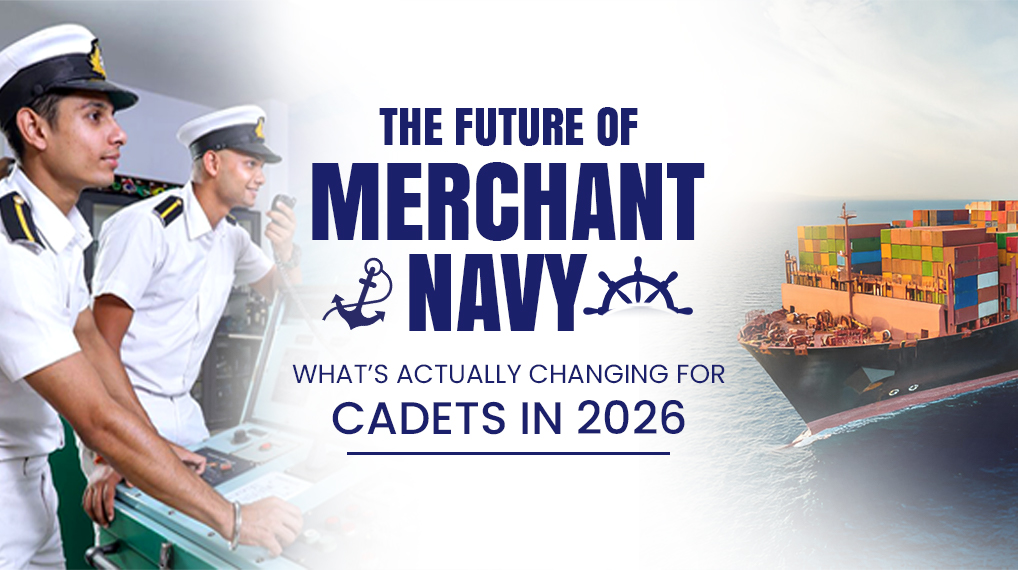
The Future of Merchant Navy: What’s Actually Changing for Cadets in 2026
Almost every counselling call this year has had some version of this question in it. A parent worried the industry’s about to get “automated away.” A student who read three blog posts and is now more confused than when he started. Somebody’s cousin who sailed in 2009 and has Opinions about how things used to be.
So — is it still worth it? Yes. But “yes” by itself isn’t really an answer, so let’s actually get into it.
Shipping is changing faster right now than it has in a long while. That part’s true, no exaggeration needed. Fuel types, regulations, the equipment on the bridge — all moving. What I’d push back on is the jump people make from “it’s changing” to “so it’s probably a bad bet.” Those aren’t the same thing, not even close.
Why this is suddenly a topic everyone’s asking about
Mostly comes down to fuel. Ships have run on heavy fuel oil for close to a hundred years — cheap, it’s basically the leftover gunk from refining crude oil, and not exactly kind to the environment. The IMO has been circling this problem for a while and last year actually approved something with teeth — a framework that costs ships money for running dirty fuel and rewards the ones that don’t. Real enforcement starts from 2027.
Shipping companies aren’t waiting for the deadline though. Lloyd’s Register tracks the order books and last I checked it was somewhere near 2,000 vessels either built or being built for LNG, methanol, ammonia, that category of fuel. LNG and methanol are way ahead of everything else right now, the rest is still catching up slowly.
India’s got its own version running too. A National Green Shipping Policy launched this year, and there’s actual money in it — 25 to 30% financial assistance for shipyards building green or hybrid vessels, depending on what they’re building. One bit that doesn’t get mentioned enough: there’s a workforce training section buried in there. Makes sense really — none of this matters if there’s nobody trained to actually run these ships.
What it means if you’re just starting out
Nobody really says this part out loud enough: the ship you do your first contract on is probably not going to look like the one your trainer worked on. Not a different career. Just a slightly different version of the same one.
If you’re going engine room side, dual-fuel systems will probably show up at some point in your career, maybe earlier than you’d expect if you happen to land on a newer ship. Ammonia’s the example everyone uses for a reason — it’s toxic, and you can’t really learn to handle it safely just by picking it up on the job. Needs its own training track, separate from the regular stuff.
Deck side has a similar story. ECDIS, route software, emissions tracking — none of that counts as “extra knowledge” anymore. It’s just part of the job now, same way radar wasn’t optional a generation back.
What hasn’t moved an inch: the basics. Seamanship. Safety drills you could do half-asleep because you’ve run through them so many times. Firefighting. Everything new just gets layered on top — it doesn’t replace any of that, whatever the headlines might suggest.
Is demand actually going up, or is this just industry noise
From everything I’ve looked at — going up, not down. Few reasons why.
Global trade hasn’t slowed. Ships still carry the bulk of world trade by volume regardless of what fuel they’re running, and that’s not changing soon. What is shifting is which skills get someone picked first for a good posting. Right now companies are short on crew who know alternative fuel systems, so that’s exactly where the better roles — and the better pay — are starting to land.
There’s a domestic angle too that doesn’t get talked about much. India wants to actually produce and supply green fuel for bunkering, not just buy it once it exists elsewhere. There’s an initiative for this — Green Ports and Shipping Network, if you want to look it up. If it delivers on even half of what it’s promising, that’s more jobs, onshore and at sea, within India — not just postings abroad like before.
Does any of this change which course makes sense
Not really. And honestly I’d push back on anyone telling students it does.
GP Rating after 10th. DNS or HND-ME after 12th if you’ve got PCM. These are still the right starting points because they teach the fundamentals the industry needs no matter what fuel a ship ends up running on. What’s different is that the learning doesn’t stop after your first certificate the way it maybe used to. STCW refreshers, fuel-specific certifications, advanced engineering modules later on — all turning into a normal part of staying employable over a 15-20 year career, not optional add-ons you skip if you can’t be bothered.
If anything, starting now isn’t a bad spot at all. You’re not walking into an industry stuck doing things the old way. You’re walking in right as it figures out the new way — which usually means more room to move up for people who keep learning past their first qualification instead of stopping there.
A Few Honest Caveats
Worth saying clearly: this shift isn’t happening as fast as some headlines make it sound. Fuel availability is still patchy, cleaner fuels cost more, and a lot of “alternative fuel capable” ships still run on conventional fuel most of the time because bunkering infrastructure for green fuels isn’t everywhere yet. So it’s a gradual shift, not an overnight one — but the direction is clear, and it’s worth understanding before you commit to a path.
If you’re stuck deciding between GP Rating, DNS, or HND-ME — just call us. We’re at Training Ship Varren in Navi Mumbai, and honestly we’d rather walk you through what each course actually involves than have you guess from a blog post. You can also check the IMO’s site directly if you want the regulation details straight from the source. Reach us at 1800 268 2891, or leave your details here and someone will call you back.