
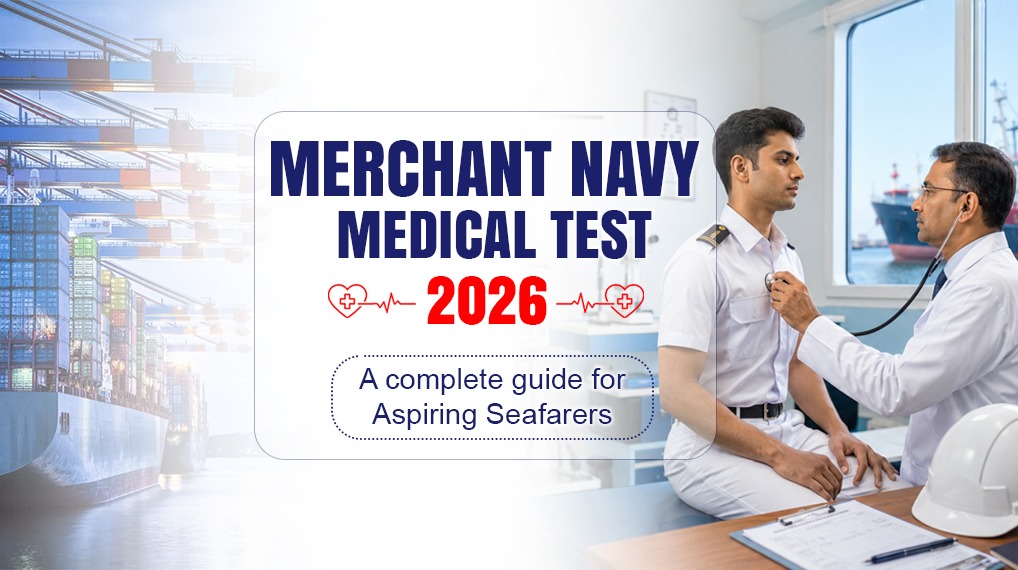
Merchant Navy Medical Test 2026 — What to Expect, What Gets You Rejected, and How to Prepare
This is the step most students don’t think about until it’s too late. You’ve done your research, picked your course, maybe already told your parents you’re joining the Merchant Navy — and then someone mentions the medical test and suddenly there are ten new questions you didn’t know you had.
So let’s go through the Merchant Navy medical test 2026 properly. What it actually checks, what gets people rejected, which rejections are fixable, and what you can do in the months before your test to give yourself the best possible chance of passing.
What Is the Merchant Navy Medical Test and Why Is It Mandatory?
The medical test isn’t just a formality. Ships operate far from hospitals, sometimes weeks from the nearest port. Because of that, every seafarer needs to be physically capable of handling emergencies, working long shifts in tough conditions, and not becoming a health liability to the rest of the crew while at sea.
The Legal Framework Behind the Test
The Directorate General of Shipping (DG Shipping), Government of India, mandates a medical fitness examination for all seafarers under the Merchant Shipping (Medical Examination) Rules, 2026 — updated rules that supersede the older 2000 framework. These rules align Indian standards with international requirements under STCW and MLC 2006.
The Two Stages You Need to Clear
You need to pass this test at two stages:
Stage 1 — Pre-Admission Medical: Before joining any DG Shipping approved maritime training institute. This confirms you’re fit to undergo pre-sea training.
Stage 2 — Pre-Sea Medical (Before Joining a Ship): Before every new contract on a vessel. Your medical certificate must always be valid when you board.
Who Can Actually Conduct This Test
One important rule that many students miss: only a DGS-approved medical examiner can conduct this examination. You cannot go to your family doctor or a general hospital for this — DG Shipping won’t accept the certificate they issue instead. Find the list of approved doctors on the DG Shipping official portal or check with your institute — they’ll usually have empanelled doctors they work with regularly.
What Does the Medical Test Actually Check?
1. Eyesight — The Most Talked About Part
Eyesight requirements differ by department, and this is where a lot of confusion happens.
For Deck Officers (DNS / ADNS / HND-NS route):
- Distant vision: 6/6 in the better eye, 6/9 in the other eye — unaided or with correction
- Near vision: N5 in better eye, N10 in the other
- Colour vision is mandatory — no colour blindness of any kind. This is a DG Shipping rule, not just a company policy. Even mild red-green colour blindness disqualifies you from Deck Officer roles. The Ishihara test chart determines this.
For Engine Officers (HND-ME / B.Tech Marine Engineering route):
- Vision requirements are slightly more relaxed than Deck
- Some colour blindness may be accepted depending on the company — however, this varies and is not guaranteed
Can you join the Merchant Navy with glasses? Yes — corrected vision (glasses or contact lenses) is acceptable for most roles, provided the corrected vision meets the standards above. Many serving officers wear glasses. What matters is your corrected visual acuity, not whether you need correction to achieve it.
Is LASIK allowed? Generally yes in 2026, but only after a specific healing period — typically 6 months minimum after the procedure — and subject to the company’s individual policy. Always consult a DG-approved doctor before undergoing LASIK specifically for merchant navy purposes.
2. BMI — Body Mass Index
The DG Shipping medical framework specifies an ideal BMI range of 18.5 to 25 for seafarers.
- Underweight (below 18.5): Indicates poor physical stamina and can lead to rejection
- Overweight (25–30): May require additional cardiac tests at some clinics
- Obese (above 30): Often leads to rejection, or clinics flag it for specialist review — because it increases the risk of cardiac events and reduces agility in emergency situations onboard
Calculate your BMI before your test: BMI = weight in kg ÷ (height in metres)²
If your BMI is outside the ideal range, you have time to work on it — especially if you start preparing months before admission.
3. Hearing
Communication on a working ship is life-critical. DG Shipping requires candidates to hear clearly at a minimum of 40dB across all standard frequencies and tests each ear independently. This standard does not allow hearing aids. If you have a known hearing issue, see a specialist early before applying.
4. Height and Physical Build
Minimum height is 157 centimetres with proportionate weight and a chest expansion of at least 5 centimetres. Additionally, the examining doctor checks for:
- No deformity of bones or joints
- No abnormal curvature of the spine
- No flat feet, bow legs, or knock knees that would interfere with duties
- No contraction or deformity of the chest
- No evidence of weak muscular development or serious malformation
5. Blood Tests and Laboratory Tests
Under the updated 2026 DG Shipping framework, a standardized set of blood and diagnostic tests is mandatory:
Blood Panel:
- Complete Blood Count (CBC)
- Fasting Blood Sugar
- Lipid Profile (Cholesterol)
- Liver and Renal Function Tests (SGPT, GGT, Creatinine)
Infectious Disease Screening:
- HIV 1 & 2
- Hepatitis A
- Hepatitis B (HBsAg)
- Hepatitis C (HCV)
- VDRL (syphilis screening)
General Checks:
- Blood pressure — must be within normal range
- Urine analysis
- Chest X-ray
- ECG (especially for older candidates or if BMI flags cardiac risk)
- Dental fitness — minimum 14 dental points required
6. Mental Health and General Fitness
Seafarers work in isolated environments, sometimes for 4–5 months at a stretch. Mental health stability is part of the fitness assessment. Candidates with a documented history of serious psychiatric conditions may face additional scrutiny. However, doctors assess common anxiety or past stress-related issues on a case-by-case basis.
Common Reasons for Medical Rejection — and Which Are Fixable
This is the part nobody explains clearly enough. Some rejections are permanent. Many are temporary and fixable if you catch them early.
Permanent / Difficult to Reverse:
- Colour blindness (for Deck roles) — no correction available; consider Engine or ETO department instead
- Permanent hearing loss — not correctable with aids for this purpose
- Serious structural deformities of spine, limbs, or chest
Temporary / Fixable:
- High BMI — diet and exercise before the test
- High blood pressure — lifestyle changes, medication (check with DG-approved doctor about medication acceptability)
- Dental issues — visit a dentist and fix cavities, missing teeth to meet the 14-point requirement
- Elevated blood sugar / borderline diabetes — dietary management
- Active infections (TB, Hepatitis B flare) — a doctor can certify you fit after treatment and cure
- Hernia or kidney stones — surgical correction before the test
- Poor eyesight (refractive error) — glasses or contact lenses are acceptable if corrected vision meets standard
Medical Certificate Validity
Under the Merchant Shipping (Medical Examination) Rules, 2026:
- Standard validity: 2 years from the date of issue
- If you’re under 18 years of age: 1 year validity
- For seafarers above 65: 1 year validity
- For COC/CDC renewal or STCW course enrollment: certificate validity must not exceed 6 months at the time of use
You must hold a valid certificate before boarding any vessel. If your certificate expires mid-voyage, it remains in force until the next port of call where a DG-approved examiner is available — but not for more than 3 additional months.
What Documents Do You Need for the Medical Test?
Carry these when attending the examination:
✅ Valid passport or Aadhaar card (photo ID)
✅ INDOS number (if already registered)
✅ CDC — Continuous Discharge Certificate (if already issued)
✅ Previous medical records if you have a known condition
✅ Prescription glasses or contact lenses if you use them
✅ Referral letter from your institute (some clinics require this)
The DG-approved doctor must verify your photo ID and record your INDOS number before issuing the certificate. The approved examiner uploads certificates directly to the DG Shipping portal — they don’t hand over a loose paper document.
How to Prepare for the Merchant Navy Medical Test 2026
Start preparing at least 3–4 months before your test date, not the week before.
Eyes
- Ask a local optometrist to check your vision first
- If you need glasses, get the right prescription and start using them regularly
- If you’re unsure about colour vision, ask the optometrist to do an Ishihara test — know your status before the official test
BMI and Weight
- Calculate your BMI and check where you stand
- If you’re outside the 18.5–25 range, work on it with a combination of diet and exercise
- Avoid crash diets — sustainable weight management over months is what matters here
Blood Tests
- Avoid alcohol for at least 48 hours before your blood test
- Fast properly before the fasting blood sugar test (8–10 hours)
- Stay well hydrated — dehydration can affect kidney function markers
- If you smoke, stopping even 2–3 weeks before the test improves blood pressure and lung capacity
Dental
- Visit a dentist at least 2 months before your test
- Fix cavities, loose teeth, or any dental issues to meet the 14-point standard
- Don’t leave dental work to the last minute — treatments need healing time
Blood Pressure
- Monitor your BP at home in the weeks before the test
- Avoid caffeine, heavy exercise, and stress the day before
- If it’s consistently high, speak to a doctor about it months ahead of time
General Fitness
- Build physical stamina with regular cardio (running, swimming)
- Sleep properly in the weeks before — chronic sleep deprivation affects blood pressure and heart rate readings
ENG1 vs DG Shipping Medical Certificate — What’s the Difference?
This comes up a lot for ADNS / HND-NS students who spend time in the UK.
DG Shipping Medical Certificate — a DGS-approved doctor in India issues this. Indian-flagged vessels and most Indian shipping companies require it for their contracts.
ENG1 Certificate — an MCA-approved doctor in the UK (or a specifically approved examiner in India) issues this. UK-flagged vessels require it. If you’re joining ships under UK MCA registration through the ADNS route, your company will tell you which certificate they need.
Some doctors in India hold dual approval — both DGS and MCA — and can issue both certificates in one visit. Check with your institute or shipping company about which one they require.
FAQ Schema
Q1: What does the Merchant Navy medical test check in 2026?
The DG Shipping medical test checks eyesight (including colour vision), BMI, hearing, blood pressure, blood tests (CBC, fasting sugar, lipid profile, liver function, HIV, Hepatitis B & C, VDRL), chest X-ray, dental fitness, and overall physical and mental health. Only a DGS-approved medical examiner can conduct the examination.
Q2: Can I join the Merchant Navy with glasses in 2026?
Yes. Corrected vision through glasses or contact lenses is acceptable for most Merchant Navy roles, provided the corrected vision meets DG Shipping standards — typically 6/6 in the better eye with correction for Deck Officers. You cannot correct colour vision; if you have colour blindness, Deck Officer roles are not open to you.
Q3: What is the BMI requirement for Merchant Navy medical test?
DG Shipping recommends a BMI of 18.5 to 25 for seafarers. A BMI above 30 (obese) typically leads to rejection or additional cardiac tests. A BMI below 18.5 (underweight) can also result in rejection due to insufficient physical stamina for sea duties.
Q4: Is colour blindness a permanent disqualification from Merchant Navy?
For Deck Officer roles (DNS, ADNS, HND-NS), yes — colour blindness of any type permanently disqualifies you. However, Engine Officer and ETO roles have more relaxed colour vision requirements and may be accessible depending on the company. Speak to a DG Shipping approved doctor for a proper assessment.
Q5: How long is the Merchant Navy medical certificate valid in 2026?
Under the Merchant Shipping (Medical Examination) Rules 2026, the standard validity is 2 years. For seafarers under 18, it is 1 year. For COC/CDC renewal or STCW courses, the certificate must have no more than 6 months remaining validity.
Q6: Who can conduct the Merchant Navy medical test in India?
Only DGS-approved medical examiners have the authority to conduct the test and issue the certificate. You’ll find the list of approved doctors on the DG Shipping official website at dgshipping.gov.in. Shipping companies and institutes do not accept certificates from non-approved doctors.
Q7: What are the most common reasons for rejection in Merchant Navy medical?
Common rejection reasons include: colour blindness (for Deck roles), BMI above 30, high blood pressure, dental deficiency (below 14 points), active TB or hepatitis, poor hearing, and structural deformities of the spine or limbs. You can fix many of these — BMI, blood pressure, dental — if you identify and address them early.
Q8: Does Training Ship Varren help with Merchant Navy medical test guidance?
Yes. At Training Ship Varren, we guide all admitted students through the medical fitness process — including connecting them with DGS-approved doctors, advising on pre-test preparation, and helping students understand whether any existing condition affects their eligibility. Call 1800 268 2891 for guidance before you apply.
If you’re planning to apply for GP Rating, ADNS, or HND-ME at Training Ship Varren and want to know whether you’ll clear the medical — just call us on 1800 268 2891 before spending money on a test. We can give you an honest read on your situation and point you to the right DGS-approved examiner. Or drop your details here and we’ll call you back.
Also check the official DG Shipping medical standards portal and the Maritime Health Branch for the latest rules directly from the source.