
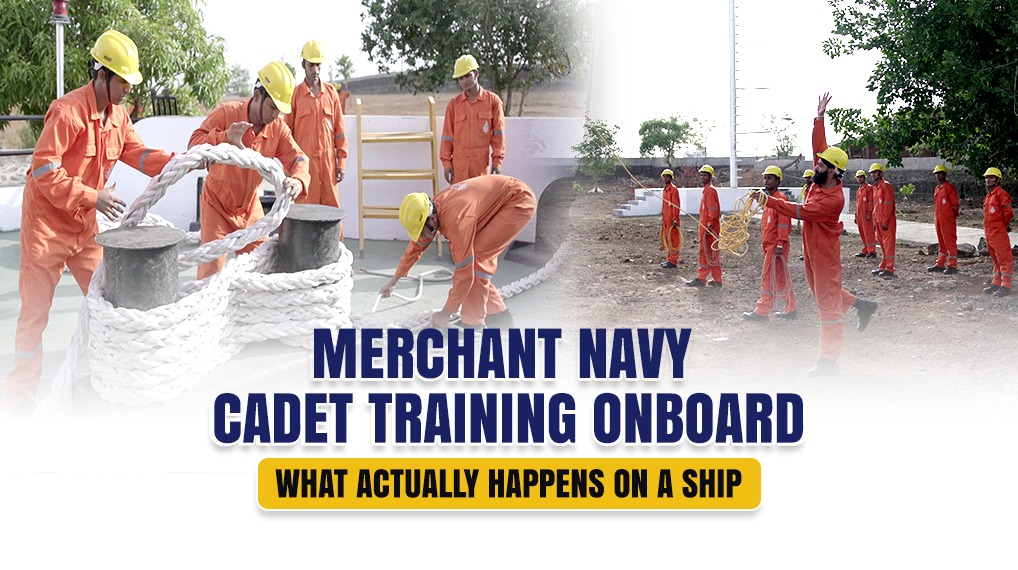
Most articles about joining the Merchant Navy stop at the course selection and the admission process. Very few explain what actually happens once you’re onboard a ship as a cadet — which is arguably the part students are most curious about and least prepared for.
So this is that article. What merchant navy cadet training onboard actually looks like, day by day, week by week — for both Deck Cadets and Engine Cadets — and what you genuinely need to know before you step onto your first vessel.
First — What Is Onboard Cadet Training?
After completing pre-sea training, cadets are placed on ships for training for a period of approximately 18 months. The cadets can take a break in between, and this could be dispersed over different ships. After their training, they are eligible to appear for competency examinations conducted by the Government of India.
In other words, the classroom phase at the maritime institute is only the beginning. Furthermore, the real learning happens onboard — where cadets apply everything from pre-sea training under the direct supervision of experienced officers in live ship operations.
This onboard training phase is called SSTP (Structured Shipboard Training Programme) for DNS cadets and structured sea time for ADNS and HND-ME cadets. During this period, cadets work as junior crew members — learning on the job, maintaining a Training Record Book (TRB), and building the sea time required to appear for Certificate of Competency exams.
The total sea time required before appearing for the Second Mate (Deck) or Class IV (Engine) exam is approximately 12–18 months of qualifying sea service, depending on the route.
Deck Cadet vs Engine Cadet — What’s the Difference?
Before getting into the daily routine, it helps to understand that onboard cadet training differs significantly depending on which department you’re in.
Deck Cadet (Navigation Department)
A deck cadet is a student officer aboard a ship who serves under senior deck officers including a Chief Officer or Captain. A deck cadet’s duties mainly consist of acquiring working knowledge of navigation, cargo operations, ship maintenance, and marine regulations.
Deck Cadets work on the bridge, on deck, and in cargo areas. Their focus is on navigation, watch duties, safety equipment, and understanding how the ship is operated and managed from a Deck Officer’s perspective.
Engine Cadet (Engineering Department)
Engine Cadets work in the engine room under the supervision of the Chief Engineer and senior engineers. Their focus is on understanding propulsion systems, auxiliary machinery, fuel management, electrical systems, and planned maintenance. Additionally, engine cadets spend significant time in the engine control room learning how to monitor and manage ship machinery.
ETO Cadet (Electro-Technical)
ETO Cadets focus on electrical and electronic systems — radar, navigation instruments, automation systems, communication equipment, and high-voltage electrical distribution onboard. This is a growing specialisation given how technology-intensive modern ships have become.
What Does a Deck Cadet’s Day Actually Look Like?
The life of a deck cadet is disciplined and follows a proper schedule every day. The routine tasks mainly include watchkeeping, deck work, cargo operations, and training. The day usually starts with morning watch duty on the bridge.
Here’s a realistic breakdown of a Deck Cadet’s typical day at sea:
0000–0400 / 0400–0800 / 0800–1200 — Watch Duty on the Bridge
Ships operate on a 24-hour cycle with officers and cadets divided into watch rotations — typically four hours on, eight hours off. During watch, the Deck Cadet stands alongside the Officer of the Watch on the bridge, assisting with:
• Monitoring radar and ECDIS (Electronic Chart Display and Information System)
• Lookout duties — especially in restricted visibility
• Recording positions, weather, and ship’s movements in the logbook
• Communication with other vessels on VHF radio
• Assisting with course alterations and speed adjustments
Post-Watch — Deck Work and Maintenance
After coming off watch, cadets are typically assigned deck maintenance tasks:
• Chipping and painting rust spots on deck
• Checking and maintaining mooring ropes and wires
• Inspecting and maintaining life-saving appliances (lifeboats, life rafts, fire extinguishers)
• Cleaning and maintaining deck equipment
Cargo Operations (at Port)
When the ship is in port, cargo operations take priority over regular watch routines. Deck Cadets assist with:
• Monitoring cargo loading and discharging operations
• Calculating draft, trim, and stability during loading
• Maintaining cargo documentation and manifests
• Overseeing hatch openings, crane operations, and stevedore coordination
Training Record Book (TRB) Entries
Every task completed onboard must be documented in the cadet’s Training Record Book — a formal log that gets signed off by the supervising officer. Consequently, maintaining your TRB properly is not optional — it’s a DG Shipping requirement and is reviewed during the COC exam process.
Meals and Rest
Fixed meal times — breakfast, lunch, and dinner — are served in the ship’s mess. Moreover, rest periods are taken seriously because fatigue is a genuine maritime safety concern. Ships follow STCW rest hour regulations, ensuring cadets get adequate sleep between watches.
What Does an Engine Cadet’s Day Look Like?
Engine Room Watch
During engine room watches, Engine Cadets assist the watch-keeping engineer with:
• Monitoring engine parameters — temperature, pressure, RPM, fuel consumption
• Checking auxiliary machinery — generators, purifiers, air compressors, pumps
• Recording readings in the engine room logbook every four hours
• Responding to alarms and assisting with troubleshooting
Planned Maintenance System (PMS)
A significant part of an Engine Cadet’s training involves participating in planned maintenance — overhauling pumps, cleaning heat exchangers, checking valve clearances, testing safety devices. Furthermore, this hands-on maintenance work builds the practical engineering knowledge that written exams alone cannot provide.
Engine Room Rounds
At regular intervals throughout the watch, Engine Cadets conduct physical rounds of the engine room — checking machinery visually, feeling for abnormal vibrations, checking oil levels, and ensuring nothing is leaking or overheating.
What Ships Do Cadets Train On?
The type of ship you train on depends on your sponsoring company’s fleet. Common vessel types for first-contract cadets include:
• Bulk Carriers — the most common first ship for Indian cadets. Relatively straightforward operations make them a good learning environment.
• Container Ships — fast-paced, port-intensive, excellent for learning cargo operations and port procedures.
• Tankers (Crude/Product/Chemical) — more specialised with additional safety training required.
• General Cargo Ships — smaller and more varied cargoes, excellent for broad exposure.
Most experienced maritime counsellors recommend starting on a Bulk Carrier or Container Ship for your first contract — the operations are more structured and the learning curve is more manageable compared to tankers or gas carriers.
Challenges New Cadets Face Onboard
1. Language and Communication
Ships are international workplaces. Consequently, you may be working alongside officers from the Philippines, Eastern Europe, or other countries. All official communication is in English — but accents, technical jargon, and communication styles vary enormously.
2. Watch Fatigue
The 4-hours-on, 8-hours-off watch system sounds manageable on paper — but it disrupts your sleep cycle significantly, especially in the first few weeks. Moreover, the physical demands of deck and engine work on top of watch duties mean fatigue is a real adjustment.
3. Distance From Family
Contract lengths for cadets are typically 4–6 months. Internet availability has improved significantly on most modern vessels — however, bandwidth is often limited and calls home require planning. Furthermore, time zone differences add another layer of difficulty.
4. Workload and Expectations
Officers on commercial ships have their own duties and responsibilities. Therefore, they don’t always have time to explain things slowly or repeat themselves. Cadets who ask good questions, show initiative, and take responsibility for maintaining their own TRB tend to get far better mentoring.
5. Seasickness
Most cadets experience some degree of seasickness in the first week or two, especially in rough weather. Fortunately, the body adapts reasonably quickly for most people — however, it’s worth knowing this is normal and almost universal for first-contract cadets.
Tips for Making the Most of Your Cadet Training
Keep your TRB updated daily — don’t let it fall behind. Moreover, a well-maintained TRB makes your COC exam preparation significantly easier since you’ve documented everything as you learned it.
Ask questions, but read the manual first — officers respect cadets who have clearly tried to understand something before asking. Additionally, the ship’s planned maintenance manuals, ECDIS guides, and stability software manuals are all available onboard — use them.
Build relationships with the crew — the bosun (deck foreman) and motorman (engine foreman) often teach practical skills that no officer course covers. Furthermore, experienced ratings have seen things on ships that no textbook describes.
Stay physically active — most ships have a small gym. Consequently, regular exercise helps with both fatigue management and mental health during a long contract.
Start COC exam preparation onboard — your 18 months of sea time goes faster than you expect. Therefore, starting to read your Second Mate or Class IV study material during your rest periods means you’re not starting from zero when you pay off.
What Happens After Cadet Training?
After completing the required sea time and passing the DG Shipping Certificate of Competency exam, cadets receive their first officer rank:
• Deck Cadets → 3rd Officer (Third Mate)
• Engine Cadets → 4th Engineer
• ETO Cadets → ETO (Electro-Technical Officer)
From there, the progression is clear — each rank requires additional sea time and further COC exams, with salary increasing significantly at each level.
| Rank | Approx. Monthly Salary |
| Deck/Engine Cadet (training) | ₹25,000 – ₹60,000 stipend |
| 3rd Officer / 4th Engineer | ₹1.5L – ₹2.5L |
| 2nd Officer / 3rd Engineer | ₹2.5L – ₹4.5L |
| Chief Officer / 2nd Engineer | ₹4.5L – ₹8L |
| Captain / Chief Engineer | ₹10L – ₹20L+ |
Merchant Navy salaries can be tax-free for seafarers spending 183+ days outside India in a financial year — qualifying as a Non-Resident Indian (NRI) under Indian Income Tax law.
How Your Pre-Sea Training Prepares You for This
The connection between what you learn at maritime institute and what you do onboard is more direct than students often realise. Specifically:
• Navigation simulators at institutes replicate actual bridge situations you encounter during watchkeeping
• Firefighting drills at the institute follow the same procedures you perform during onboard safety drills
• Stability calculations you practice in class are the same ones you do during cargo operations
• Engine room simulators prepare Engine Cadets for the exact machinery configurations they find onboard
At Training Ship Varren, our DNS, ADNS, and HND-ME programmes are specifically structured to bridge this gap — ensuring cadets arrive onboard their first ship with practical confidence, not just theoretical knowledge. Similarly, our GP Rating programme prepares ratings for the exact deck and engine department tasks they’ll perform from day one.
FAQ
Q1: What is merchant navy cadet training onboard?
Merchant navy cadet training onboard is the practical sea-time training that follows pre-sea training at a maritime institute. Cadets spend 12–18 months onboard commercial vessels under the supervision of senior officers, learning navigation, cargo operations, engine room management, and safety procedures in real working conditions. This sea time is mandatory before appearing for DG Shipping Certificate of Competency exams.
Q2: What does a deck cadet do onboard a ship?
A deck cadet assists senior officers in bridge watchkeeping, navigation, cargo operations, safety equipment maintenance, and deck maintenance work. Daily duties include standing 4-hour bridge watches, monitoring ECDIS and radar, recording ship movements in the logbook, participating in cargo loading and discharging operations, and maintaining a Training Record Book.
Q3: What does an engine cadet do onboard a ship?
An engine cadet works in the engine room under senior engineers, monitoring propulsion systems, auxiliary machinery, fuel management, and electrical systems. Duties include standing engine room watches, conducting machinery rounds, participating in planned maintenance, recording engine parameters in the logbook, and documenting training in the Training Record Book.
Q4: How long is merchant navy cadet sea time training?
The required sea time for merchant navy cadets is approximately 12–18 months of qualifying service onboard ships. DNS cadets complete 18 months of Structured Shipboard Training (SSTP). ADNS and HND-ME cadets complete the sea time required by their respective DG Shipping and MCA approved programmes.
Q5: What is a Training Record Book (TRB) in merchant navy?
A Training Record Book (TRB) is a formal log that every merchant navy cadet maintains onboard, documenting all training tasks completed under the supervision of senior officers. Each completed task is signed off by the supervising officer. The TRB is a DG Shipping requirement and is reviewed during the Certificate of Competency examination process.
Q6: What is the stipend for merchant navy cadets during sea training?
Merchant navy cadet stipends during sea training typically range from ₹25,000 to ₹60,000 per month, varying by company, ship type, and course route. In addition to stipend, the company provides free food, accommodation, travel, and medical coverage onboard.
Q7: What type of ship do cadets train on first?
Most first-contract cadets train on Bulk Carriers or Container Ships — both are commonly recommended as good first ships because the operations are more structured and the learning curve is manageable. Tankers and gas carriers typically prefer cadets with prior sea experience.
Q8: How does pre-sea training at Training Ship Varren prepare cadets for onboard training?
Training Ship Varren’s DNS, ADNS, HND-ME, and GP Rating programmes include simulator-based navigation and engine room training, firefighting and safety drills, stability and cargo calculations, and practical deck and engine workshops — all structured to match the real tasks cadets perform onboard from day one of their first contract. Call 1800 268 2891 or visit trainingshipvarren.com for course details.
Ready to Start Your Maritime Career?
Call Training Ship Varren on 1800 268 2891 or visit trainingshipvarren.com/admission-inquiry/ — we’ll walk you through which course puts you on the fastest and most practical path to your first ship.
DG Shipping portal: dgshipping.gov.in | DG Maritime Affairs: dgma.gov.in